Science often begins with a question, but it only becomes meaningful when people understand why that question matters. For biomedical illustrator and science communicator Jeffrey Tao, that simple idea has become the foundation of his work. Whether he is illustrating molecules, designing journal covers or collaborating with researchers, his goal is not only to explain science accurately. It is to help people reconnect with the human story behind it.
As Jeff puts it, “If my mission could be boiled down to one sentence, it would be to reconnect researchers with their work.” He has chosen visual storytelling, content creation and mentorship as the way to do it.
Beyond Scientific Illustration
Scientific illustration has traditionally focused on accuracy. Jeff values that precision and recognises its importance. “If you can’t see the molecule, well now you can,” he explains. Creating an accurate visual representation of research allows people to appreciate things that would otherwise remain invisible. “Literal is okay too. Accurate is okay too.”
But accuracy is only the beginning. For Jeff, every research project eventually arrives at a more important question. “So this is your what, then so what? How does this connect with humanity? Why are we paying tax dollars for this?”
That shift changes everything so that rather than stopping at what a molecule looks like or how a biological pathway functions, Jeff asks how the research changes lives. Who benefits? Who is waiting for this discovery? What problem is being solved? Those are the stories that audiences remember.
Every Discovery Has a Human Face
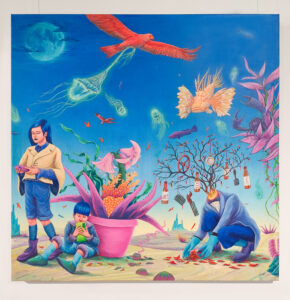
One project that illustrates this philosophy became the front cover of journal Environment and Health. The research focused on inorganic arsenic contamination in groundwater. Jeff could have illustrated the chemistry alone. Instead, he centred the people living with its consequences.He depicted rural communities in Bangladesh, showing a woman drawing water from a well, a child drinking it and the invisible chemical processes unfolding inside the body that eventually contribute to disease. The science remained accurate, but the illustration became about more than metabolism.
“We’re not just here investigating how arsenic is metabolized in a human body,” he explains. “We’re doing this because it’s been a serious problem in one part of the world.” As similar contamination has been identified elsewhere, the research has become part of a much larger global story. “That’s the story here and that’s what people care about.” It reflects a principle that extends well beyond scientific illustration. Facts inform us. Stories help us care. Art does not replace scientific evidence. It provides the context that allows evidence to become meaningful.
Interestingly, Jeff’s storytelling is not directed only at the public. He also hopes to reconnect scientists with the reasons they entered research in the first place. Research careers can become consumed by experiments, grant deadlines and publication targets. In the process, it is easy for the broader purpose to fade into the background. Jeff does not believe everyone approaches science for the same reasons, nor does he think his role is to persuade people to adopt his perspective. Instead, he simply wants to invite those who are interested to see research through another lens.

Storytelling is Part of Science
For many people, storytelling and science occupy different worlds. Jeff sees them as inseparable. “Storytelling is how it’s been done for ages through communities, through the history of humanity.” “When we stop telling stories, actually, that’s where we start losing sense of what we’re doing. That’s where we start losing as a society the importance of science.”
It is an observation that feels increasingly relevant. Scientific discoveries continue to accelerate, yet public trust in science often struggles to keep pace. Information has become easier to access, but understanding remains uneven. Technical expertise alone is rarely enough to build connection. So he shares his perspective that telling stories can help us cross those bridges so that our shared spaces can feel smaller.
Jeff believes storytelling reminds people why science exists in the first place. It creates common ground between researchers and communities that may feel disconnected from scientific institutions. It helps create the conditions where evidence can actually be heard.
Where Art and Science Meet
Jeff’s work demonstrates that art and science are not competing ways of understanding the world. They answer different questions that become stronger together. Science asks what is happening and how. Art asks why it matters. When those perspectives are brought together, research becomes more than data on a page. It becomes something people can recognise in their own lives, communities and futures.Perhaps that is why scientific storytelling has become such an important part of interdisciplinary practice. It reminds us that every graph represents people. Every experiment begins with curiosity, and every discovery carries the possibility of improving someone’s life.

Watch the full conversation on Art-Sci Currents via Spotify, YouTube and Apple Podcasts.We’re releasing new episodes every Thursday this summer.