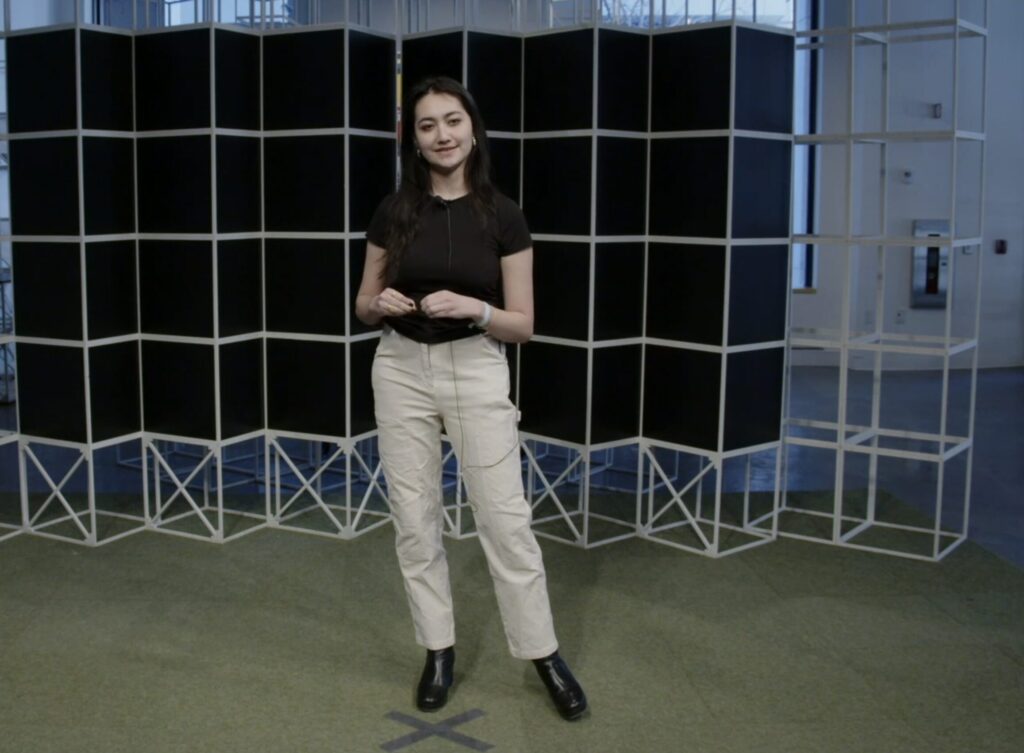
For Emma, ageing is not a concept to define. It is something to move through, to question and to understand from the inside out. Her work brings together dance, research and conversation, shaped not only by academic study but by the voices of those living the experience. Through discussions with colleagues across performance, science and community practice, she builds a layered picture of how movement changes over time and what those changes reveal.
Her PhD research at Concordia University in Montréal recently led to her winning the Three Minute Thesis competition, where she distilled her work into a clear and compelling narrative. At its core, her project asks a deceptively simple question: what happens when we stop treating ageing as decline and begin to understand it as transformation?
This question is grounded in her applied research on accessible dance-based fall prevention for older women, where she has been developing and teaching online ballet-informed movement classes designed to support balance, strength and confidence in everyday life. Working with participants in both urban and rural contexts, her research explores not only measurable changes in physical stability, but also how people experience movement differently when it is delivered in accessible, community-based formats.
Within the Public Scholar Program at Concordia University, she has engaged in ongoing discussions with international dance-for-health researchers, with a particular emphasis on accessibility and movement practices for older adults. We had the pleasure of hearing from her colleagues and learning more about the contributions of their work and perspectives.
The Body as a Site of Knowledge
Dr Rosaria Gracia, an associate lecturer at the Open University in the UK, describes dance for health as something that reaches far beyond physical exercise. Her work with an intergenerational community programme that began in 2012 sits alongside other emerging research exploring how movement-based approaches can support health, wellbeing and independence across the lifespan.
In Dr Gracia’s sessions, she highlights how dance can be fun, expressive and non-competitive, making it a powerful way to motivate people to move and stay active over time. This focus on accessibility and enjoyment sits alongside Emma Chen’s work, which similarly explores how movement-based health interventions through accessible online dance programs can help remove barriers to participation and support more inclusive, sustainable approaches to ageing and wellbeing in older adults.
In addition to exploring fitness outcomes of dance on ageing, Dr Gracia emphasizes the wider effects that emerge through participation: increased confidence, stronger communication, improved wellbeing, and a growing sense of social connection. For many participants, she explains, the sessions become a space for belonging, where people not only move together, but also build relationships and feel part of a community.
At the same time, Dr Gracia is careful not to overstate its effects. She notes that dance is not a “magic formula” and does not work the same way for everyone. It can require time, resources, and ongoing commitment. It is not a quick fix. While biomedical approaches tend to focus on quantifiable outcomes, she suggests not missing some of what dance offers in the social, emotional and experiential changes that unfold through movement over time.
Letting Go of Fixed Forms
Another colleague highlights how movement must adapt to changing bodies, particularly in the context of dementia care and accessibility. Rather than focusing on fixed choreography or technical performance, Dr Heun Lee describes dance as something that can be reshaped to meet people where they are. Her work centres on removing barriers to participation through language support, community-based settings and the use of culturally familiar materials so that older adults can engage safely and meaningfully in dance, regardless of physical or cognitive ability.
In this framing, movement becomes less about precision and more about inclusion, responsiveness and shared experience. Participants are encouraged to move in ways that suit their own bodies, with no requirement to memorize steps or follow a strict sequence.
In Emma’s view, accessible online dance for older adults similarly explores how movement practices can be redesigned to expand access and support participation in later life. In both cases, dance is not treated as a fixed skill to be maintained, but as a practice that can be adapted to support wellbeing across changing circumstances.
The Role of Community in Ageing
A third perspective that runs strongly through Emma’s colleagues is the role of community. Dance, as she and her colleagues describe it, does not happen in isolation, and neither does living with neurological conditions such as Parkinson’s disease.
This is reflected in projects like Diagnostic Imaginings, where artists, researchers, clinicians and members of the Parkinson’s community come together through dance, music and other art forms. As Dr Louise Campbell and Dr Naila Kuhlmann explain, the aim is not only to create artistic work, but to support knowledge exchange, empathy and communication of lived experience. In their work, movement and sound become shared languages through which different perspectives between the scientific and the personal can meet.
Within this context, participation itself becomes a collective practice. People contribute in different ways: through movement, through music, through reflection on experience. A person living with Parkinson’s may lead movement, while others translate that movement into sound or respond through scientific insight. The result is not a single interpretation of experience, but a layered, co-created understanding of it.
This emphasis on shared creation closely echoes Emma’s broader reflections on community in dance practice. Across both contexts, dance is not positioned as an individual achievement, but as something shaped through interaction: between bodies, between disciplines and between ways of knowing.
Participants as Contributors
Emma’s broader approach to dance-ageing research brings together different ways of knowing movement in practice. Across these conversations, knowledge is not positioned as something produced only in academic settings, but as something that emerges through collaboration between researchers, practitioners and participants.
A 3-Minute Thesis project described by Siobhán O’Reilly, a physiotherapist and intergenerational practitioner, reflects this kind of practice-based knowledge-making. Her work on developing an intergenerational dance programme begins with a gap in the research: while such initiatives exist, they are often under-documented, inconsistently evaluated and rarely examined in terms of outcomes like physical activity or social connection. Rather than treating this as a purely academic limitation, she responds by co-designing a programme with both older adults and teenagers, refining it through participation and feedback.
Elements such as mirroring, social dance and shared reflection are not fixed in advance, but tested and adapted with participants over time. In this sense, participants are not only subjects of study, but active contributors to how the intervention takes shape and what it comes to mean.
A More Expansive View of Ageing
Across these presentations, evidence is not seen as something separate from practice, but as something generated through it. Here, dance becomes a site of art–science integration, where art and science methodologies are inherent to process. Knowledge emerges through movement, reflection and analysis in tandem, with lived experience and research continually shaping ideas in real time.
What is seen in Emma and colleagues’ work is a more expansive understanding of ageing. It does not deny challenge, but it refuses to reduce ageing to limitation. There is still effort, still adjustment, still uncertainty. Yet there is also depth, awareness and creative possibility.
In bringing together research, conversation and practice, Emma offers a perspective grounded in this art–science exchange: one that reflects the complexity of the body, and the richness of lived experience when seen through multiple, interconnected ways of knowing.