What began as a fellowship exploring ballet and motor neuroscience grew into something far larger, a global mapping of minds between art and science that refuse to stay in one lane. These are their stories.
When I joined Building 21’s TOSI × BLUE Fellowship, supported by The Neuro at McGill University, I arrived with a clear mission: embark on my deep desire to bridge ballet and motor neuroscience.
But fellowship programs, especially like the inquisitive and thought-provoking environment inherent to Building 21, have a way of expanding the lens you look through!
I started my fellowship by convening MOTION Talks, a discussion series on art-science integration, where students from Concordia University, McGill University and institutions across North America and beyond joined in person or Zoomed in to share their personal art-science journeys. Their experiences, language and visions make something unmistakably clear, the hunger for art-science integration wasn’t niche. It wasn’t just about dance and the brain. It was everywhere, in everyone’s work, hiding under different names and different disciplines.
“Art and science, seemingly disparate at first glance, share common ground in their pursuit of truth, expression and exploration.”
What emerged from those eight weeks of conversation was a deep reflection on the weight, necessity and importance of interdisciplinary thinking. It was more than a career choice; it was a way of being that many felt they weren’t allowed to tap into. Our discussions led to notes and conversations that lit up our discussion room, unfolded a shared language for interdisciplinarity and instilled hope for a future that we graduate students didn’t currently see.
Out of our reflections, we discovered that art-science is adaptive and flexible. Its rules and principles aren’t clear-cut. It has a place that is not to remove the credibility of art or science, but to add a third space of possibility for new ideas to emerge across boundaries. We found that art-science integration may not stem from 50-50 contributions of either field, but that there is a time and place for the two to inform each other, not just side by side, but through an integrated form of contribution.
For us, these five categories open the conversation to describe what happens when art and science truly integrate.
- Science Inspires Art
- Science Studies Art
- Art Communicates Science
- Art Inspires Science
- Art Meets Technology
Art and Science
Graduate Students
Discussion Weeks
01 Science Inspires Art: When the lab becomes a muse
Scientific ideas and discoveries serve as a catalyst for artistic expression, inspiring the exploration and visualization of scientific concepts in unique and unexpected ways.
Long before the fellowship, artists have been turning to science not for answers, but for new questions to ask through form and movement. When choreographer Wayne McGregor began embedding scientific knowledge and research into his choregraphic practice, he wasn’t illustrating textbook knowledge, he was using the body as a site of scientific curiosity, drawing from studies on perception and proprioception to reshape how performers engage with space.
Internationally, the work of artist-in-residence programs at institutions like CERN and NASA has produced a generation of creators who treat particle physics and astrophotography as artistic raw material. Luke Jerram’s large-scale glass sculptures of viruses and bacteria — scientifically accurate to the nanometre — began as a meditation on colour-blindness and became iconic public art seen across dozens of countries. The science gave him the form; the art gave it meaning.
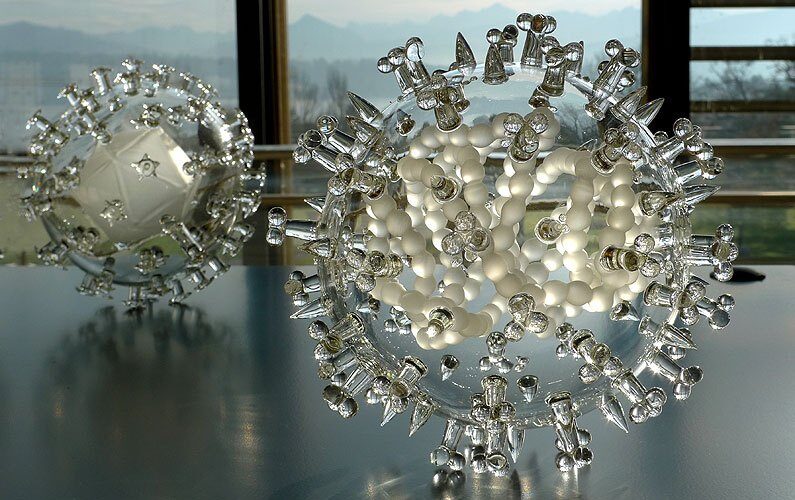
My own entry point to this fellowship was exactly this category. Research on motor learning, specifically how the brain encodes and refines movement sequences, directly shape my approach to dance technique, teaching and choreography.
What these examples share is directionality: the scientific discovery arrives first, and the artistic response follows in a transformed, not transcribed, manner. Science offers the raw material, while art offers a form of interpretation.
02 Science Studies Art Putting creativity under the microscope
Scientific methodologies seek to understand the biological, behavioural and cognitive processes behind artistic practice — examining how the brain and body engage in expression and technique to produce artistic form.
What happens inside a musician’s brain during improvisation? How does a dancer’s nervous system differ from a non-dancer’s? These questions belong to a growing field of empirical research that treats art-making as a window into human cognition, motor control and emotional regulation.
The work of neuroscientist Anjan Chatterjee at the University of Pennsylvania brought neuroaesthetics, the science of how the brain processes beauty and art, to mainstream attention. By scanning brains during aesthetic experiences, researchers have identified distinct neural signatures that activate during artistic engagement, offering biological evidence for what artists have always intuitively known: that making and receiving art is profoundly embodied.

Surgeon and musician Charles Limb used fMRI scanning to observe what happens in jazz musicians’ brains during improvisation. He discovered that the dorsolateral prefrontal cortex (associated with self-monitoring) deactivates during improvisation, while the medial prefrontal cortex (linked to self-expression) lights up — providing neurological evidence that creativity involves a deliberate loosening of self-censorship.
03 Art Communicates Science: Making the complex accessible
Artistic methods translate complex scientific ideas into accessible and engaging forms — enhancing public understanding and making science more approachable to diverse audiences.
Science communication is one of the most urgent challenges of our era. Peer-reviewed publications remain largely inaccessible to non-specialist audiences, and the growing distrust of institutional science demands new modes of public engagement. This is where art steps in!
The Wellcome Collection in London has built an entire institutional identity around this premise: using visual art, photography, illustration and performance to invite public audiences into conversations about health, the body, and medicine. Their exhibitions regularly feature artists who have worked directly with scientists, creating immersive experiences that allow viewers to feel what it is like to live inside a scientific phenomenon.
Similarly, Nathalie Miebach translates raw meteorological data, such as wind speed, barometric pressure, precipitation, into three-dimensional woven sculptures and musical compositions. The same dataset becomes both a visual and an auditory experience, demonstrating how artistic encoding can communicate scientific data to people who would never read a climate report.
04 Art Inspires Science: When creativity drives discovery
Artistic expression drives scientific inquiry — leading to new hypotheses, experimental approaches and innovative solutions within the science field.
The influence here runs in the opposite direction from category one. Here, it is the artist’s sensibility, process or observation that opens a new door in scientific thinking. History is full of these moments, but they are often obscured because science tends to narrate its own origin stories.
Santiago Ramón y Cajal, the Nobel Prize-winning neuroscientist who produced the first accurate drawings of neurons and synaptic structures, was also an accomplished artist. His practice of meticulous visual observation — trained through drawing — was inseparable from his capacity to see what no one before him had seen in nervous tissue. His art became a method, and the aesthetic attention he brought to the microscope was what made the science possible.
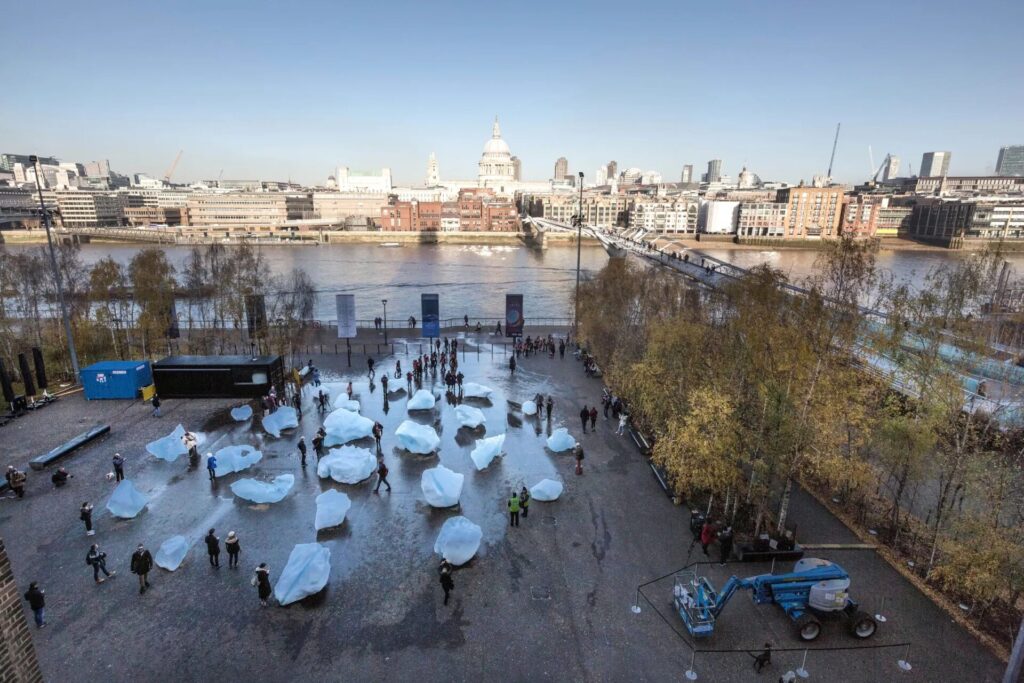
In 2020, I came across The Art of Design docuseries on Netflix, where I was introduced to (and blown away by) both Neri Oxman and Olafur Eliasson. Olafur Eliasson is a large-scale installation artist who incorporates natural properties and elements, such as light, water and physics, into his works. In 2014, his project Ice Watch, in which he placed blocks of glacial ice in public spaces and let them melt, forced scientists and policymakers into a direct, sensory confrontation with glacier retreat data. More than one glaciologist has cited public art installations as the moment that shifted their communication strategy and drove new research questions about the psychology of climate engagement.
05 Art Meets Technology: New tools, new forms, new questions
Category five was the last to emerge from our discussions of art-science integration. Yet, it is perhaps the most visible in contemporary culture. The best art-technology integration is about a genuine co-evolution, where artistic needs push technology beyond its designed limits and where technological capability reshapes artistic possibility.
teamLab, the Tokyo-based interdisciplinary collective, builds immersive digital environments that require custom software engineering to produce. Their need to render light as a fluid, interactive material has driven genuine advances in real-time rendering and motion tracking. The art required the technology to become something new. Similarly, when Radiohead wanted to visualize sound as three-dimensional geometric form for their “House of Cards” music video, they partnered with Google to use LIDAR scanning technology in a way that had never been done for artistic purposes. The resulting workflow influenced how LIDAR was subsequently applied in architectural scanning.
teamLab’s permanent museum in Tokyo deploys custom software, 520 computers and 470 projectors to create environments where digital artworks “overflow” from room to room, responding to visitor presence. The technical demands of the artistic vision drove meaningful advances in real-time computer graphics and sensor-based interactivity — the art made the technology better.
The Art-Scientist is not a hybrid, but a new kind of thinker
Across eight weeks of MOTION Talks, thirty student stories and seventy-plus art and science specialities, we found five categories of art-science that contribute to a vocabulary for a conversation that is still beginning.
What if interdisciplinary thinking, where ideas stem from the fusion of artistic pursuits and empirical knowledge, became the standard across all levels of human advancement? That was the question The CreMAP Directory project, through Building 21, proposed to ask, but what The Crearte Foundation ultimately grew to embrace. What emerged from those eight weeks of conversation was the beginning of a global map of art-scientists. And from our shared dialogue, the MOTION Book—a ten-page coffee table art book featuring essays from the emerging art-scientists I encountered along the way—became a tangible imprint of that journey, carrying forward not just our ideas, but the momentum to keep expanding this interdisciplinary movement.
I’d like to express immense gratitude for Building 21, McGill University, TOSI – The Neuro, and the incredible art-scientists I got to meet in a year of connecting, discussing and learning. Want to see more about this project? Order the MOTION Book below.
MOTION: The Emerging Art-Scientist, Volume 1 Winter 2024