If you ask Francesco Scarel how he became one of Europe’s compelling voices in art-science curation, don’t expect a straight line. His path runs from a nanotechnology PhD to a decade of documentary filmmaking, through a prestigious master’s in science communication, and into founding Liminal Research, the Trieste-based organization he now leads. Ask him how it all fits together, and he’ll tell you, with a laugh, that it was never planned at all.
Starting With What You Can’t See
Scarel’s first love was chemistry, drawn to it, he says, because molecules are invisible yet they build the entire visible world. But somewhere in the middle of his PhD, he began noticing the walls around the work: the “macro world of rules” that every research question lives inside. A workshop with MIT’s Felice Frankel cracked something open. He realized he wasn’t fully a scientist and wasn’t fully an artist either, and that the discomfort of being “in the middle” wasn’t a problem to solve. It was where he was supposed to be.
That realization didn’t lead him gently into a new career. It led him out of the lab entirely and into documentary filmmaking, working on social and educational projects, including video-based Italian language teaching that had nothing to do with science at all. He needed the break completely, he explains, because “if you change, you have to do it properly.”
Serendipity Isn’t an Accident
Ten years later, a master’s program in science communication brought the two halves of his life back together, and it’s here that Scarel’s thinking becomes most useful to anyone trying to work across disciplines. He talks often about serendipity, but not as luck. He describes it as something you can’t design, only facilitate: the right people, in the same physical or conversational space, given enough freedom to be wrong out loud. Forced multidisciplinary meetings, he notes, tend to fail. What works is an open, low-ego environment where people are still free to say “maybe this isn’t true” and mean it.
Curating Without a Script
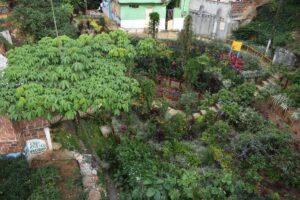
As a curator through Liminal Research, Scarel’s method is less about imposing ideas and more about matching them: pairing an artist’s vision with the right lab, or starting instead from a community’s need and building outward from there. He described a recent wetland restoration project where his role wasn’t to introduce something new, but to help a natural reserve’s existing plans become more participatory, working with local schools so children could help imagine what the restored landscape might look like.
Underneath all of it is a working philosophy he applies equally to curation and to teaching: the goal isn’t to shape what someone thinks, but to extract what’s already there. People are curious by default, he argues. The job of a teacher, or a curator, is mostly to ask better questions and offer just enough structure that ideas don’t dissolve into talk without ever becoming something concrete.
A Direction, Not a Map
What actually got Francesco Scarel from chemistry to filmmaking to curation wasn’t a five-year strategy. It was a direction loose enough to survive being wrong, and a willingness to let new ideas reshape the original one instead of clinging to it.
That, more than any single project, is the thread running through his career, and the reason his story resonates well beyond art-science circles. It’s a case for staying oriented without needing to be certain, and for treating the discomfort of being “in the middle” not as a problem to fix, but as the place where the most interesting work quietly begins.
Passing On the Cultural Tools
Scarel is candid that a lot of what drives him now is less about his own next project and more about what he can pass on. He talks about wanting to help train a generation to have the cultural tools necessary to engage fully with the world around them, not just artistically or scientifically, but civically: the capacity to take part in political conversations, understand what’s at stake in a debate, and make informed choices about their own communities. For him, this isn’t an abstract goal. He traces it back to his own childhood, to the adults who let him build things with his hands that quietly cracked open his thinking long before he had any language for what art-science even meant. Teaching, in this light, isn’t about handing down conclusions. It’s about giving people the tools to keep asking better questions long after the workshop ends.