What does it mean to see something clearly? And does seeing necessarily mean understanding?
For Eleonora Adami, a postdoctoral researcher working in cardiovascular research, these questions extend beyond the laboratory. Trained in molecular biology and genomics, she also works with illustration and experimental art, exploring how images shape our understanding of the world. Her practice moves between communicating scientific knowledge and questioning how we come to know what we see.
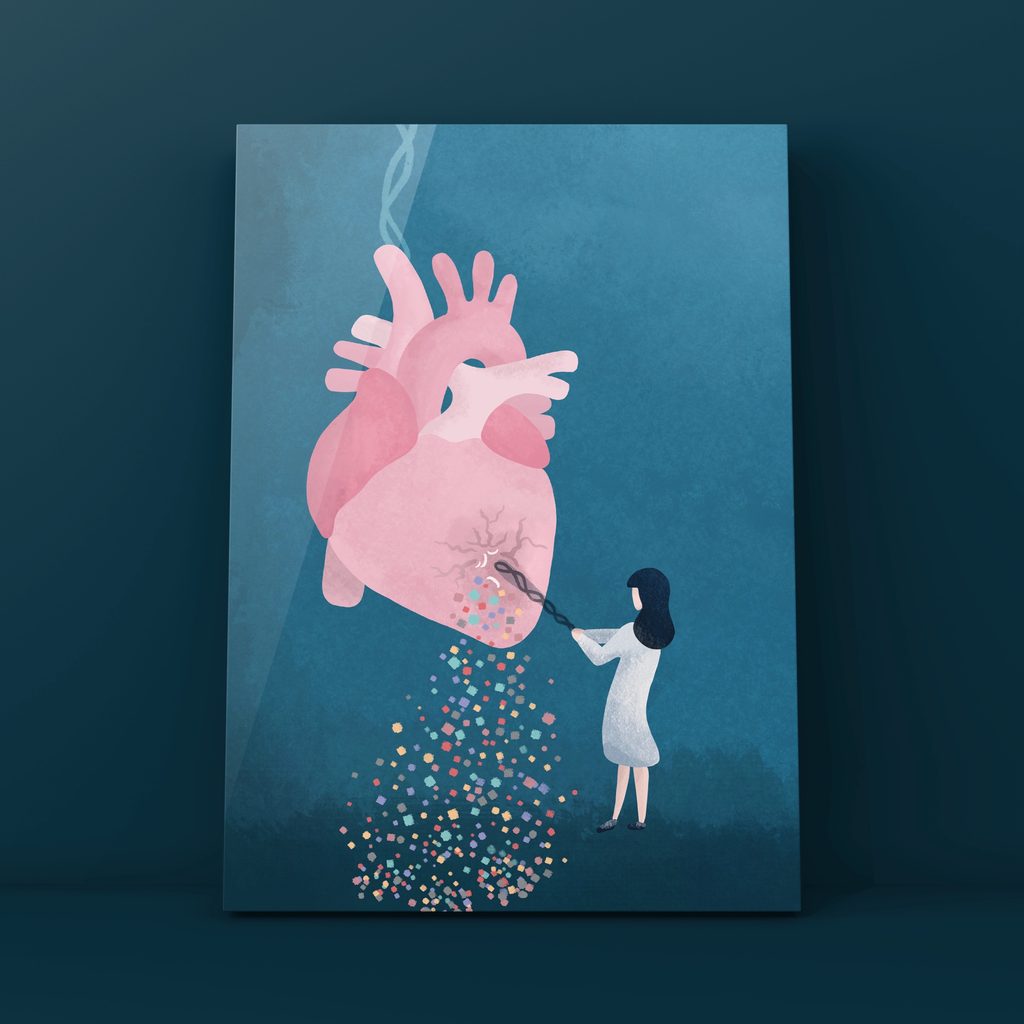
It is a combination that feels natural to her. As a child, she kept a journal filled with observations and drawings of zebra finches. Looking back, she sees an early indication of the relationship between careful observation and creative expression that continues to inform her work today.
For Adami, drawing is not simply a way to represent an idea after it has been understood. It is a way of thinking through the idea itself.
Drawing to Understand
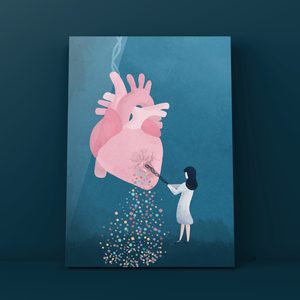
Scientific research often involves working with information that is difficult to grasp through words alone. Biological processes can be complex, with multiple structures and relationships operating at once. Illustration offers a way to make these relationships visible.
Adami uses drawing to process information, clarify her understanding and communicate scientific concepts to colleagues and wider audiences. What began as a personal way of thinking has developed into a practice that supports her research and helps others engage with it.
This relationship between visual thinking and scientific understanding is an important part of art-science practice. Images can do more than simplify complicated information. They can help researchers identify relationships, recognize patterns and communicate ideas that might otherwise remain difficult to follow.
Yet Adami’s artistic interests extend beyond illustration as a tool for explanation. Alongside her scientific communication work, she develops personal projects that explore perception, memory and the nature of knowledge itself.
These projects create room for a different kind of inquiry. Rather than illustrating what is already known, they invite audiences to consider how knowledge is formed in the first place.
When Seeing Is Not the Same as Knowing
In her artwork To See Is to Know, Adami places contact lenses on a mirror to explore the relationship between perception and knowledge.
The materials are simple, but their relationship creates an intriguing tension. Contact lenses are designed to clarify vision. A mirror offers a reflection of what is in front of it. Together, however, they complicate the assumption that what we see provides a complete or objective account of reality.
The contact lenses can clarify and distort the reflected image, prompting viewers to consider how perception is shaped by the instruments through which we observe the world. Even when something appears clear, our understanding of it may remain incomplete.
The work connects with Adami’s scientific interests while opening up broader epistemological questions: how do we know what we know? What can observation tell us, and where does interpretation begin?
Presented at a science event in Berlin, the artwork generated conversations about perception and memory. Rather than providing a single explanation, it created an opportunity for people to bring their own interpretations to the work.
This is one of the distinctive possibilities of art-science. Scientific illustration often aims to make a concept clearer. An experimental artwork can take the opposite approach, making an apparently familiar concept strange enough that we begin to question it.
Both approaches have value. One helps us understand what we are looking at. The other asks us to reconsider how we look.
For Adami, moving between these approaches allows her scientific and artistic practices to inform one another without requiring them to serve the same purpose.
Building a Space Between Disciplines
Despite the possibilities of interdisciplinary work, building a career that combines art and science is not always straightforward.
Adami identifies a lack of infrastructure and support for people who want to maintain both practices. Scientific and artistic institutions have their own expectations, professional networks and measures of success. Someone working between them may find that their work does not fit comfortably within either system.
She also raises an important imbalance in the opportunities available for collaboration. Artist-in-residence programmes have created ways for artists to work within scientific institutions. The reverse arrangement, with scientists taking up residencies in artists’ studios, is much less common.
This raises a question about what meaningful interdisciplinary exchange should look like. If the goal is to bring art and science into closer conversation, opportunities need to exist for both communities to participate, learn and influence one another’s work.
There are encouraging examples. Adami points to initiatives at the Max Delbrück Center, where exhibitions and events bring scientists together with musicians and other creative practitioners. These encounters help create opportunities for exchange beyond the formal structures of research.
She is also interested in expanding her own exhibition opportunities and making science art more familiar to audiences who might not ordinarily encounter it. Her hope is not simply to bring artworks into scientific venues, but to help science-based art find a place within wider artistic contexts.
This distinction matters. When scientific ideas enter galleries, exhibitions and public cultural events, they can reach people who may never read a research paper or attend an academic lecture. Artistic settings also allow audiences to engage with scientific ideas through curiosity, interpretation and personal experience.
The challenge is to build the connections that make these encounters possible without reducing art to a communication tool or science to a source of inspiration.
Curiosity Beyond the Laboratory
Adami’s creative interests extend beyond her current projects. She is learning to play the theremin, an electronic instrument played without physical contact, and is interested in experimenting with oil pastels as another artistic medium.
These details offer a glimpse of the broader curiosity that underpins her practice. Creative exploration does not always need to serve a research objective or produce a
finished project. Sometimes, learning an unfamiliar instrument or trying a new material is valuable simply because it opens up another way of experiencing the world.
That freedom to experiment is worth protecting in interdisciplinary work. Not every encounter between art and science needs to result in a new technology, a publication or a measurable outcome. Some projects create value by changing how people see a subject, giving them a new question to consider or allowing them to connect with an idea in an unexpected way.
Adami’s work moves between explanation and exploration. Through scientific illustration, she helps make complex biological processes more accessible. Through experimental art, she invites audiences to question the assumptions that shape their understanding.
Art and science may approach knowledge differently, but both depend on curiosity and the willingness to look more closely. Their intersection creates space not only to communicate what we know, but also to explore the limits of that knowledge.
Sometimes, the most interesting question is not whether we can see clearly. It is what we might discover when we begin to question what seeing means.
Explore more of Eleonora’s work here:
Website: www.brushandpipette.com